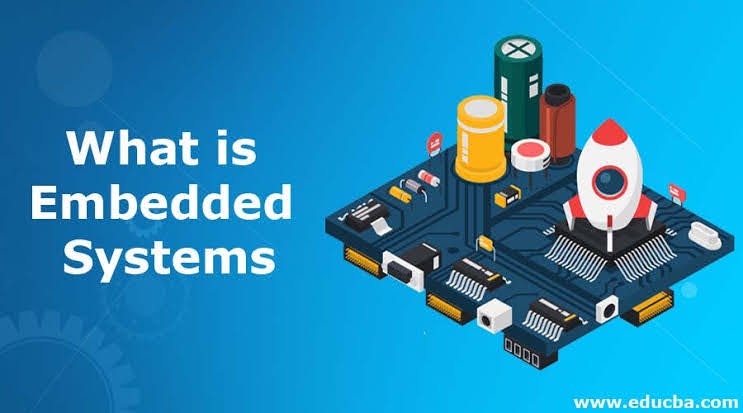
An embedded system is a microprocessor-based computer hardware system with software that is designed to perform a dedicated function, either as an independent system or as a part of a large system. At the core is an integrated circuit designed to carry out computation for real-time operations.
- These may or may not have network connectivity.
- They interact with the user via simple interfaces like digital cameras, tv or cellphones.
- They interact with other devices like disk drivers, memory sticks, etc. (indirect interaction with the user), invisible to the user.
- Efficiency is the most important factor when talking about embedded systems especially when used in cost critical markets(ex- consumer electronics), power critical markets(ex- military and medical).
- Embedded systems are application specific: They perform one task or set of related tasks.Design is focused on one application. Therefore, Higher design efficiency is possible.
General structure of embedded systems:

Sensors
- Receive information from environment
- Example: simple- thermistor, photo resistor,etc. Complex- CMOS camera, Ethernet controller, etc.
ADC (Analog-Digital Conversion)
- Analog input is converted to digital format
- Ex: sound(pressure wave overtime) → microphone(converts pressure to voltage) → voltage is sampled over time and Each voltage sample is represented as a digital number.
DAC (Digital-Analog Conversion)
- Digital formatted data is converted to analog form.
Actuator
- It causes the events to occur in the environment.
- Ex: simple- leds, lcds. Complex- servomotors, ethernet controller, etc.
Processor
- Micro controller
- Ip
- fgpa
- Micro controllers:
- Integrated circuit that executes a program
- Smaller and weaker than microprocessor
- Connected to other hardware components, sends and receive data
- Needs to be programmed. The programmer needs to write a program and transfer the program from the host to the microcontroller.
- Programming hardware can be used to place programs in microcontroller memory.
- Properties and characteristics:
- Data path bandwidth- no of bits in each register. Determines accuracy and data throughput.
- input/output pins- to support application
- Performance- clock rates are slower than desktop
- Timers- needed for real time applications
- Low power modes
- Communication protocol support- interface with other ics. Ex- UART, SPI,12C,etc
- Components of micro controller:
Storage elements:
1. Registers- store single values
2. Memories-
a) cache- stores many values. Slower than registers.
i)Data cache- holds data that the program operates on.
ii)Instruction cache- holds programs instructions.
b) Main memory- larger when compared to other types. However it is slower in nature and is therefore cheaper.
It is not in cpu but is connected to cpu via system bus.
2. IP
- Intellectual property core
- Integrated circuit that performs one function
- Predesigned component
- Cheap in high volume
- Useful for common tasks: ex- network controllers(ethernet, LAN), audio/video(audio codec, VGA controller).
- Must interact with microcontrollers.
3. FGPA
- Field programmable gate array
- Hardware that can be reconfigured via RAM which can be rewired or reconfigured to perform other tasks.
- Faster than SW, slower than ASIC
- No fabrication needed
Copyright © 2020 Megha’s Mind Curls- All Rights Reserved
 Megha's Mind Curls